Thomas Wakley (the Bare-knuckle Surgeon) and James Lambert (The Honourable Doctor) were recognised in my Address at:
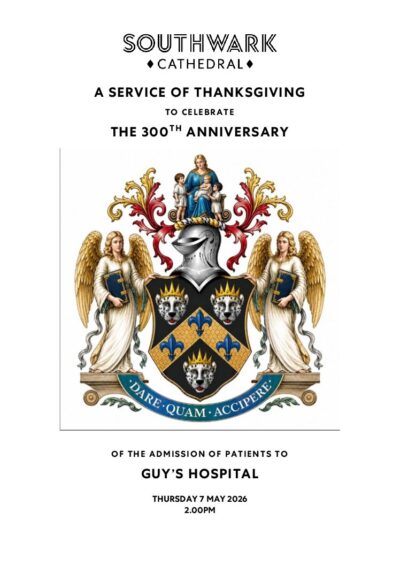
Service of Thanksgiving to celebrate the 300th Anniversary of the admission of patients to Guy’s Hospital
held in Southwark Cathedral on 7 May 2026 when the hospital was blessed by the Bishop of Southwark.
The Guy’s men who initiated modern health care
The early years of the 19th century witnessed radical challenges across all areas of life. Most of those planting the seeds of the so-called Regency Revolution are well-recognised today – in literature Jane Austen, in art Turner and Constable, in science Humphrey Davy, in engineering Thomas Telford and John McAdam, and in poetry Byron, Shelley and Keats.
But little attention has been paid to health care. Yet, it too was embarking on profound changes in which the foundations of what we would recognize as modern services were laid.
Though it would take several decades, it was two Guy’s alumni – Thomas Wakley and James Lambert – who sparked the transformation of the medical profession and the way the great public hospitals were organised and managed.
Guy’s, like the other six major London hospitals, was in desperate need of reform. Anarchy ruled.
- Doctors treated patients with little recourse to scientific evidence and there was no scrutiny of their clinical competence, even from colleagues.
- And those who taught, with some honourable exceptions, had little interest in their pupils beyond welcoming the handsome reward of the tuition fees.
- And to be appointed to a hospital post, nepotism was rife:
- William Lucas, widely known by Guy’s staff and pupils as the ‘cock-handed surgeon’, inherited his post from his talented and skillful father, Billy Lucas;
- even the great Sir Astley Cooper, who had himself inherited his position as surgeon from his uncle, appeared proud that he’d succeeded in getting six nephews and godsons appointed to the hospital staff.
- Meanwhile, patients’ views were ignored. They were expected to be grateful for being there regardless of the outcome of their treatment
- And those who funded the hospitals, the governors and subscribers, displayed no interest in what went on as long as the good name of the hospital was not besmirched, jeopardizing its financial future.
Overall, health care in England was controlled through the hospitals and Colleges by a handful of self-serving London doctors.
Until then, no one had dared challenge the status quo.
All this was to change when, on Saturday 5 October 1823, in a small printers just off The Strand, a radical new journal rolled off the press, the like of which had never been seen.
The Lancet was the brain child of Guy’s alumnus Thomas Wakley aided and abetted by William Cobbett, two medical friends and, I believe, Thomas’s wife, Elizabeth.
It broke all the long held beliefs about medical periodicals:
- That a weekly publication could never succeed
- That doctors only want to read about medicine, not the arts let alone chess
- That the lectures given to medical pupils which contained the most up-to-date knowledge couldn’t be shared more widely
- And most importantly, that it wasn’t acceptable to criticize fellow doctors’ competence.
Wakley would have none of it.
The anger and consternation The Lancet caused was exactly as he’d intended. The editors of the existing medical periodicals labelled him “an outcast of medical society” and a “literary pirate and disseminator of moral garbage”.
But despite such vitriol, The Lancet exceeded even Wakley’s expectations. Within two years it had 4000 subscribers which rapidly rose to a staggering 12 000. The established periodicals, with a few hundred subscribers at best, understandably were furious.
Wakley had proved that The Lancet was what ordinary doctors wanted: up to date scientific know-how on common diseases alongside powerful denunciations and challenges to those in control of the profession and the hospitals, an establishment seen as holding back the development and improvement of health services.
He certainly succeeded in annoying and irritating the powerful, but after five years the Lancet had had little discernible impact. A second initiative was required, one in which Wakley was aided by another Guy’s alumnus, James Lambert.
A general practitioner on Walworth Road and a reporter for The Lancet, Lambert was shocked to see a patient in Guy’s endure almost an hour on the operating table being cut for stone, a procedure that took only a few minutes in the hands of a skilled surgeon. Not surprisingly, the patient succumbed the next day.
Although it was a huge risk, Wakley determined that publication of Lambert’s damning account would so incense senior members of the medical establishment they would insist the surgeon, who happened to be a nephew of Sir Astley Cooper, must sue for libel.
Wakley’s stratagem paid off. For the first time, a doctor’s competence in a public hospital would be scrutinised in public with the world watching. It was to prove a turning point in medical history.
The case was heard eight months later, in the Court of King’s Bench in Westminster Hall, the highest court in the land.
For two days Wakley and Lambert were criticised mercilessly by no less a barrister than the Attorney General. Leading doctors were prepared to defend the surgeon, despite none of them having actually observed the operation.
National newspapers held their presses awaiting the verdict, something they’d only ever done once before when awaiting news of the death of George III.
When, around midnight, the verdict came, the large crowd outside in New Parliament Square celebrated. The jury deemed that it was indeed the surgeon’s incompetence that had killed the patient.
There was no going back. Doctors could now be held accountable for their actions, heralding the start of what has proved to be a long journey of reform, involving many men and women, establishing the accountability of doctors and of hospitals.
Even today, that journey has not yet been completed but we have two Guy’s men to thank for starting us along that road, men with extraordinary vision and courage.