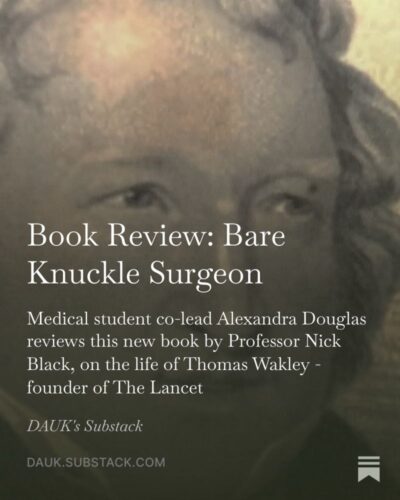
In Bare-knuckle Surgeon, Nick Black uses historical fiction, based on real events, to show just how deeply medicine was shaped by rigid hierarchy and an obsession with status, often at the expense of the patients it claimed to serve. It exposes a system established largely through nepotism, gatekeeping, and mutual protection. The impact is something like pressing on a bruise as this story about the past remains uncomfortably recognisable today. The book lays bare a system where reputation shielded senior doctors from criticism and where questioning those at the top of the chain was wholly unacceptable.
Thomas, the protagonist, is the quintessential outsider. He was born into a farming family, without connections, took up bare-knuckle fighting to pay for his studies, and spent his life proving his skill to a profession that overlooked him. His passion for surgery was matched by relentless grit and unwavering dedication. Medicine was central to who he was, not simply a legacy he had inherited or was expected to uphold. Even after qualifying, he remained on the margins whilst his peers were offered fellowships and opportunities by virtue of family name. His frustration is palpable, and this fuels his motivation to assert change over the current narrative.
One of the most striking threads in the book is its portrayal of medicine before any real evidence-base existed or was accepted. Senior physicians practiced whatever they preferred, backed by anecdote, experience, or tradition. Change moved at a glacial pace, and innovation spread only if the right person approved of it. Newly graduated doctors often became accidental messengers of new ideas simply because they’d rotated through London’s hospitals. Thomas repeatedly challenges the outdated practices of those in charge, advocating for patient care above any desire for status. His protest leads to multiple episodes of career stagnation, and he loses standing within the medical community. He is backed into a corner, faced with an unspoken ultimatum from the establishment: conform to us completely or accept that you’ll never be a surgeon.
That’s what pushes Thomas and a small group of like-minded colleagues to create The Lancet. This it was an act of rebellion. A deliberate attempt to force medicine to confront its blind spots, share knowledge freely, and to let go of blind hierarchy. In addition to his drive for reform, Thomas wanted the journal to open doors for new medical practices and make advancements accessible to doctors across the country. In a sense, he sought to action the principle of ‘justice’.
We’re living in a time where evidence is routinely misquoted, misrepresented, or stripped of nuance to serve political narratives. Research is cherry-picked to justify policy rather than guide us toward new solutions. At the same time, doctors are expected to work in a system that demands flawless outcomes, as if a profession defined by human factors can ever be free of mistakes. If anything, the story is a reminder that accountability is not about blame, it is about integrity and honesty. Mistakes should be examined, not buried. They’re inevitable in a career that deals with limitless uncertainty and without access to all of the answers. A dangerous doctor is not one who does not make errors; it is one who refuses to admit they exist.
Bare-knuckle Surgeon ultimately asks whether we have truly left the traditional hierarchy behind. It is a story about reform, evidence, and the power to speak up when the system applauds silence. That is why it matters.
Alexandra Douglas, Doctors’ Association UK